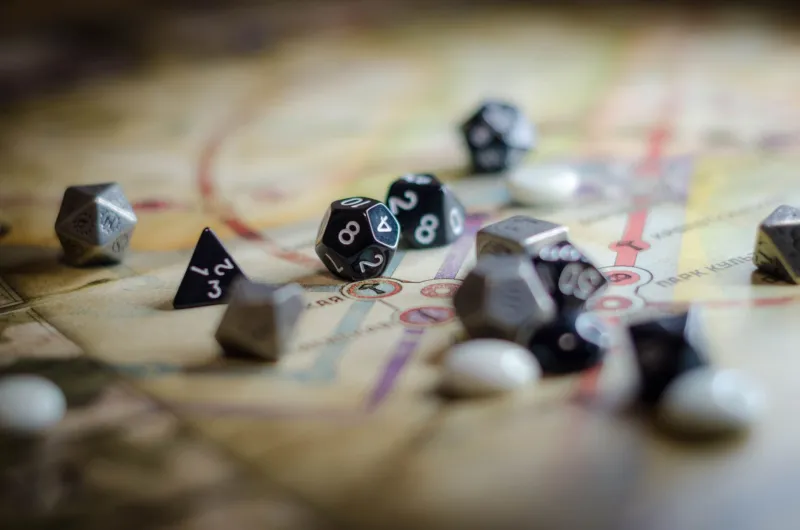
Your Players Are Obsessed with Your Map — Here's How to Use That
You spent three sessions crafting a morally complex antagonist. You planted clues in tavern rumors and hidden journals. You had a whole dramatic reveal planned for session eight.
And then your players spent forty-five minutes arguing about whether two mountain ranges could geologically coexist.
Welcome to one of tabletop gaming's most delightful curveballs: the player who falls completely in love with your world's geography. Not the story sitting on top of it — the actual physical, spatial, cartographic reality of the place. And honestly? If you know how to work with it instead of against it, this obsession might be the best thing that ever happened to your campaign.
Why Geography Hooks Players So Hard
There's something uniquely grounding about a map. When a player can point to a location and say we were here, and now we need to get there, the world stops feeling like a collection of set pieces and starts feeling like a real place. Geography creates consequence. Distance matters. Terrain shapes culture. Rivers determine where cities grow.
Players who fixate on maps aren't being difficult — they're engaging at a deep level. They're asking the world to make sense on its own terms. That's the dream, right? A world that feels lived-in and logical, not just a backdrop for encounters.
The problem is most GMs — even experienced ones — build outward from narrative needs rather than inward from geographic logic. You needed a desert because the story called for one. You put a capital city on a peninsula because it looked cool. You didn't think too hard about where the food supply comes from or why anyone would build a town at the base of an active volcano. And that's totally fine — until your players start asking.
When the Questions Come, Don't Panic
Here's the scenario: your player who definitely minored in geography IRL is squinting at your hand-drawn map and asking why the major river flows toward the mountain range instead of away from it. Everyone at the table is looking at you.
First rule: don't treat this as an attack. It isn't. It's investment.
Second rule: you don't have to have the answer right now. "That's a great question — what do you think is going on there?" is one of the most powerful phrases in a GM's toolkit. Seriously. Throwing the question back at the table doesn't make you look unprepared; it makes you look collaborative. And half the time, your players will invent an explanation that's more interesting than anything you would've come up with under pressure.
Maybe that backwards river is the result of ancient magical engineering. Maybe there was a cataclysm that reversed the watershed. Maybe there's a divine spring at the mountain's peak that defies natural law — and now there's a religious order built around protecting it. You didn't plan any of that. Your player's nitpick just handed you a campaign hook.
Turning Spatial Logic Into Story Gold
Once you recognize that player geography obsessions are a resource, you can start mining them deliberately. Here are a few ways that plays out in practice.
Trade routes become political intrigue. When players start tracing the most logical paths between cities, they'll notice chokepoints — mountain passes, river crossings, narrow coastal straits. Ask yourself: who controls those chokepoints? Suddenly you've got a merchant guild with a stranglehold on commerce, a border town that's secretly more powerful than the capital, or a smuggling operation running through a cave system that bypasses the official route entirely.
Cartography errors become history. Older maps were wrong all the time — coastlines were misdrawn, inland territories were pure guesswork. If your players notice that two different maps of your world disagree, that's not a continuity error you need to fix. That's evidence of a world that changed. What happened between the first map and the second? A war that redrawn borders? A flood that swallowed a coastline? A kingdom that doesn't want its true territory known?
Population math becomes cultural depth. The moment a player asks "wait, how does this city feed itself? There's no farmland nearby," you've got an opportunity. Maybe they import everything and are therefore vulnerable to blockades. Maybe there's underground agriculture, or magical food production, or a dark secret about where the food actually comes from. Scarcity shapes culture in ways that ripple through everything — religion, class structure, military priorities.
Practical Tools for Improvising on the Fly
You can't pre-plan answers to every geographic question. But you can build a mental toolkit that helps you improvise confidently.
Keep a "geographic logic" cheat sheet. A few basic real-world principles go a long way: rivers flow downhill, cities form at river confluences and natural harbors, mountains create rain shadows, trade follows the path of least resistance. When players ask something you haven't considered, run it through these filters first.
Establish your world's "exception rules" early. If your world has magic, decide what geographic impossibilities magic can explain. A levitating city, a frozen desert, a forest that grows in total darkness — these become lore pillars rather than inconsistencies if you acknowledge them as deliberate anomalies.
Build a "geographic mysteries" list. Every time a player asks a spatial question you don't have an answer to, write it down. Don't answer it in the moment — let it sit. Come back to it before the next session and decide: is this a mystery the players can eventually solve? A piece of ancient history? A current political secret? Some of your best long-term campaign threads will start exactly this way.
Embrace the Cartographers in Your Party
If you've got a player who genuinely loves maps — who draws their own version of your world, who tracks distances and journey times, who notices when your geography doesn't add up — treat that player like gold. They're doing worldbuilding labor for you, and they're doing it out of love.
Consider giving them in-world reasons to care. Maybe their character is a cartographer, a navigator, a land surveyor. Maybe they find an ancient map that contradicts everything they know. Maybe a faction specifically recruits people with their character's geographic expertise.
When a player's real-world passion intersects with their character's in-world role, something magical happens. The table stops playing at the world and starts playing inside it.
That napkin coastline you scribbled? It just became the most important document in the campaign. Let it.