Every Coin Has a Story: Turning Your Treasure Hoards into Living Pieces of Your World
There's a moment in almost every campaign where the players crack open a chest, and the GM says something like, "You find 400 gold pieces, a +1 sword, and a potion of healing." The players nod, someone updates their character sheet, and the game moves on.
Nothing wrong with that, technically. But imagine instead: "You find a silk-wrapped bundle containing a cavalry saber — its crossguard stamped with the crest of a kingdom that fell two hundred years ago. Beside it, a leather purse holds coins minted in a currency your merchant character has never seen. And tucked beneath both, a small iron key with no obvious lock."
Same mechanical value. Completely different effect on the table.
That's what we're digging into today — how to reverse-engineer your treasure from your world outward, so that every find feels like it belongs somewhere real.
Loot as Archaeological Evidence
Here's the mental shift that makes everything else click: stop thinking of treasure as a reward you're handing out, and start thinking of it as evidence.
Every item in your world exists because someone made it, owned it, used it, and eventually lost it. A pile of gold in a dragon's hoard didn't teleport there — it traveled through dozens of hands, crossed borders, changed meaning, and accumulated history. When you design treasure with that in mind, the items stop being mechanical bonuses and start becoming windows into your setting.
Ask yourself: Where did this come from? Who owned it before? Why did it end up here? The answers don't all need to surface immediately — some of the best worldbuilding is the kind players piece together over multiple sessions — but you need to know, even if it's just a few sentences in your notes.
The Economy of Your World Lives in Its Loot
One of the most overlooked worldbuilding opportunities in a treasure hoard is the mundane stuff. The coins.
Real-world economies are messy and fascinating. Medieval merchants dealt in dozens of different currencies simultaneously, some debased, some rare, some politically loaded. Your fantasy world can — and probably should — work similarly.
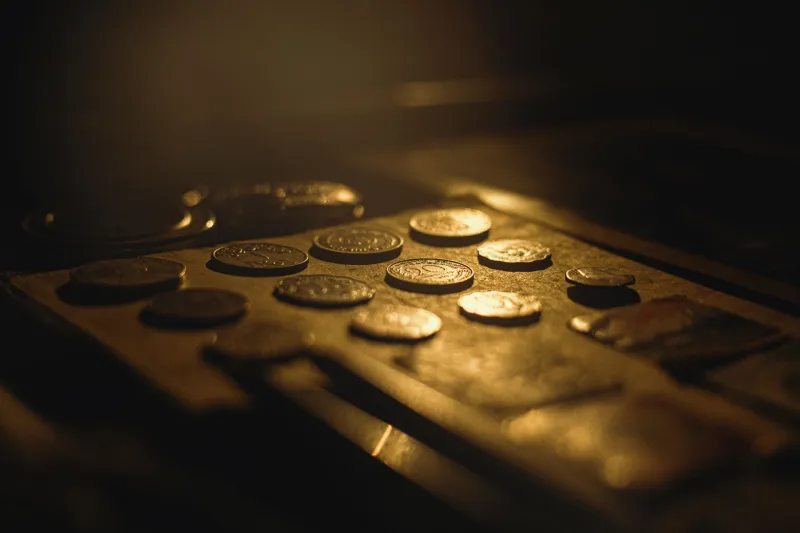
Consider: what if your players regularly encounter coins from a specific empire that no longer exists? Those coins are still in circulation because they're made of real silver and merchants don't care about politics. But finding a stash of only those coins, in mint condition, raises questions. Why were these hoarded? Was someone stockpiling wealth before a collapse they knew was coming?
You can also use trade goods and luxury items to communicate economic geography. Spices from a distant southern continent, silk that only comes from one city-state, dyes that are illegal to export — these aren't just flavor, they're maps. Players start to build a picture of your world's trade routes and power structures just by paying attention to what keeps showing up in treasure.
Culturally Specific Artifacts Do the Heavy Lifting
Generic magic items — Sword +1, Ring of Protection, Boots of Elvenkind — are functional. But culturally specific artifacts are interesting.
A sword is a sword. But a sword whose blade is inscribed with funeral rites in a language only the party's cleric can read? That's a conversation starter. A shield painted in the heraldic colors of a noble house the party has only heard mentioned in rumors? Now the players are asking questions.
When you design culturally specific loot, you're essentially creating props for your worldbuilding. You're giving players something tangible to interact with, something they can take to an NPC scholar and learn more about, something that might connect to a plotline three sessions from now.
Here's a practical framework: for every significant magic item in your campaign, answer these three questions before it enters play.
- Who made this, and why? A weapon forged for a specific war carries different weight than one made for a merchant's bodyguard.
- What's its cultural context? Is this item common or rare in its place of origin? Is it sacred? Taboo? Illegal?
- How did it end up here? Conquest, trade, theft, inheritance, accident — the path an item traveled tells you a lot about the world it traveled through.
You don't need to dump all of this on players at once. Drip it out. Let them discover it.
Cursed Items as Historical Footnotes
Cursed items have a reputation for being annoying — and they can be, if they're just mechanical traps designed to punish players. But reframed as historical artifacts, they become something much more interesting.
A cursed sword that compels its wielder toward aggression isn't just a gotcha. It's an object with a story. Maybe it was enchanted by a battle-mage who wanted to create the perfect soldier and overshot badly. Maybe it carries the echo of the warrior who died wielding it, unable to let go. Maybe it's not cursed at all by the culture that made it — it's working exactly as intended, and the players' moral framework is what makes it feel wrong.
Cursed items done this way generate roleplay, faction drama, and lore questions organically. Players stop seeing them as something to immediately identify and discard, and start seeing them as puzzles worth engaging with.
Building Backward from Your World's History
The most efficient way to design meaningful loot is to start with your world's history and work forward.
Take a major historical event in your setting — a war, a cataclysm, a dynasty's fall, a great migration. Now ask: what physical objects would that event have produced, scattered, or destroyed? What would survive two hundred years later, and in what condition? Who would be looking for it, and why?
A collapsed empire might leave behind currency, weapons, religious artifacts, and administrative seals — all of which could theoretically show up in a treasure hoard. A magical catastrophe might have left behind items with residual, unstable enchantments. A cultural diaspora might mean that specific craft traditions appear far outside their geographic origin.
This approach also helps you avoid the randomness problem. When treasure feels arbitrary, players treat it as arbitrary. When it clearly belongs to the world — when it makes sense that this specific item is in this specific place — players lean in.
A Note on Restraint
Not every piece of loot needs to be a narrative breadcrumb. If every single item in your world comes with a three-paragraph history, players will start tuning out. The power of meaningful treasure comes partly from contrast — most coins are just coins, so when one coin is different, it means something.
Pick your moments. Seed significant items at meaningful intervals. Let the mundane be mundane so the significant can actually land.
Your world is built from countless small details that accumulate into something that feels real. Treasure is one of the most tactile, immediate ways to deliver those details — literally placing history into your players' hands. Use it.