Let the Walls Do the Talking: Designing Dungeons That Carry Their Own History
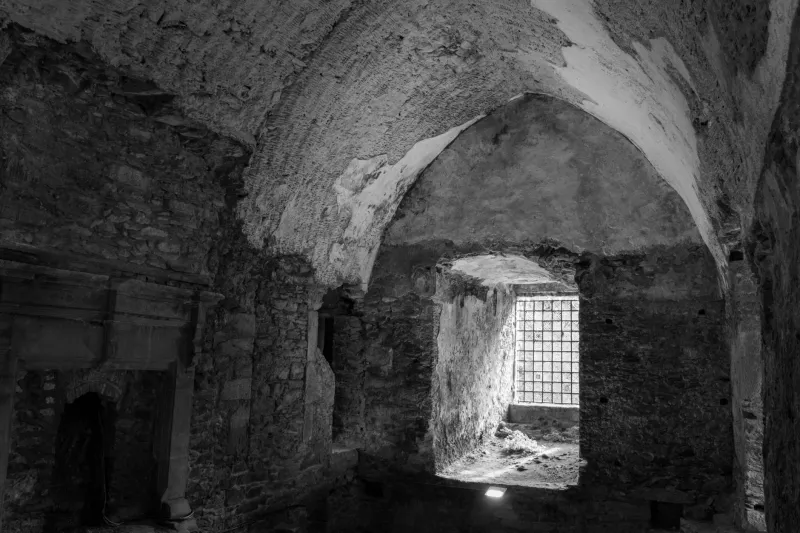
There's a particular kind of magic that happens when your players stop moving and just look. Not because you told them to, not because a helpful merchant handed them a pamphlet about the dungeon's tragic backstory — but because something in the room caught their eye and made them go, "Wait. What happened here?"
That's environmental storytelling doing its job. And it's one of the most underused tools in a GM's kit.
Most of us were taught to front-load lore. Drop an NPC with a speech, leave a conveniently legible journal, or just narrate the history as the party walks in. And yeah, sometimes that works fine. But when you build a dungeon that communicates through its bones — through architecture, object placement, physical damage, and spatial logic — you create something players actually want to explore. They're not receiving a story. They're solving one.
Here's how to make that happen.
Start With a Before-Picture in Your Head
Before you design a single room, ask yourself one question: what did this place look like when it was alive?
A dungeon isn't born a dungeon. It was a temple, a fortress, a laboratory, a palace, a mine. Something happened — invasion, abandonment, corruption, catastrophe — and time did the rest. If you know what it was before, you can scatter the evidence of that transformation throughout every room.
Say your dungeon was a dwarven forge-complex, abandoned after a cave-in sealed the lower levels and the survivors never came back. That means:
- Upper rooms are relatively intact — tools still hanging on hooks, cold forge pits, ore carts rusted on their rails
- Middle rooms show signs of hasty departure — half-eaten meals turned to dust, personal effects left behind, a locked strongbox that was never retrieved
- Lower rooms are collapsed, flooded, or sealed with crude rockfall that someone built in a hurry from the inside
Now you have a dungeon with a spine. Every room can reflect a moment in that history without you ever having to explain it directly.
Architecture Is Personality
The way a civilization builds tells you everything about what it values.
High vaulted ceilings with elaborate stonework? These people wanted to feel small in front of something greater than themselves — religious or hierarchical. Low, functional corridors with efficient right angles and recessed torch brackets? Pragmatists. Military. People who didn't waste stone on aesthetics. Organic, asymmetrical chambers with carved reliefs everywhere? A culture obsessed with legacy and memory.
When players walk into a new section of your dungeon and the architecture shifts, they should feel it. A sudden change from rough-hewn stone to polished marble isn't just visual variety — it's a signal. Something different was built here, by different hands, for a different purpose. Let them wonder why.
Layering two or three architectural eras into a single dungeon is one of the richest things you can do. The original structure, something built over it or into it by a later culture, and then the ad hoc additions of whatever's living there now — each layer tells a chapter of the story.
Objects in Rooms Are Sentences
Every object you place in a room is a word in a sentence your players are reading. The question is whether those words add up to something coherent.
Random clutter says nothing. Intentional clutter says everything.
A broken chair in the corner of a barracks room is set dressing. Three broken chairs, all shoved against the same wall, and a door on that wall that's been nailed shut from the inside — now that's a story. Something came through that door. People were scared enough to barricade it with whatever they had. They didn't make it out, or they did but never came back to fix any of it.
Try this exercise: for each room you design, write one sentence that describes what happened in that room during the dungeon's final days. Then figure out what physical evidence that event would leave behind. A struggle leaves overturned furniture, drag marks, maybe a dropped weapon. A ritual gone wrong leaves burn patterns, shattered components, organic residue. A slow abandonment leaves dust, personal items, and things that were too heavy to carry.
You don't have to place all of it. But if you know the sentence, the details you do place will feel intentional.
Use Spatial Relationships to Build Tension
Where rooms are in relation to each other is itself a form of storytelling.
A grand throne room that can only be reached by walking through the servants' quarters? That's either a design flaw or a deliberate power statement — the ruler wanted supplicants to pass through the mundane before reaching the sublime. A heavily fortified outer gate that leads to an inner sanctum with almost no defenses? Whatever's in that sanctum, it wasn't meant to be protected from the outside. It was meant to be kept in.
Think about sightlines, too. If players can see into the next room before they enter it, that's an invitation to observe before acting. If a room has a second-floor gallery overlooking the main floor, that space existed for a reason — surveillance, ceremony, tactical advantage. Put something up there. Even if it's just old bones and a collapsed railing, it tells players this room had layers of use.
Damage Patterns Are Eyewitness Accounts
This is the detail most GMs skip, and it's one of the most powerful tools you have.
Fire damage radiates outward from a source. If the scorch marks on the walls form a rough circle centered on a stone dais, something on that dais burned. Explosion damage is chaotic, spraying outward in multiple directions. Weapon damage is specific — sword cuts are horizontal or diagonal, axes leave different marks than blades, and something with claws leaves parallel gouges.
Blood spatter (and yes, this gets a little grim, but it's a dungeon) has directionality. A spray across a wall tells a different story than a pool on the floor. One suggests violence in motion; the other suggests something or someone fell and didn't get up.
You don't need to be a forensics expert. You just need to ask: if this terrible thing happened here, what would the physical aftermath look like? Then describe that, and let your players connect the dots.
Give Players Something to Argue About
The goal of environmental storytelling isn't to deliver a complete, unambiguous history. It's to give players enough to form theories — and enough ambiguity that those theories can differ.
If your players walk out of a dungeon and immediately start debating what actually happened there, you've done it right. "I think the cultists turned on each other." "No, something got in from below — look at the direction of those claw marks." "What if the thing that got in was already there?"
That conversation is its own reward. It means they were paying attention. It means the dungeon felt real enough to have a history worth arguing over.
And honestly? It means the walls did their job.