Ink, Ego, and Bad Surveying: Why Your Campaign Map Should Be Wrong

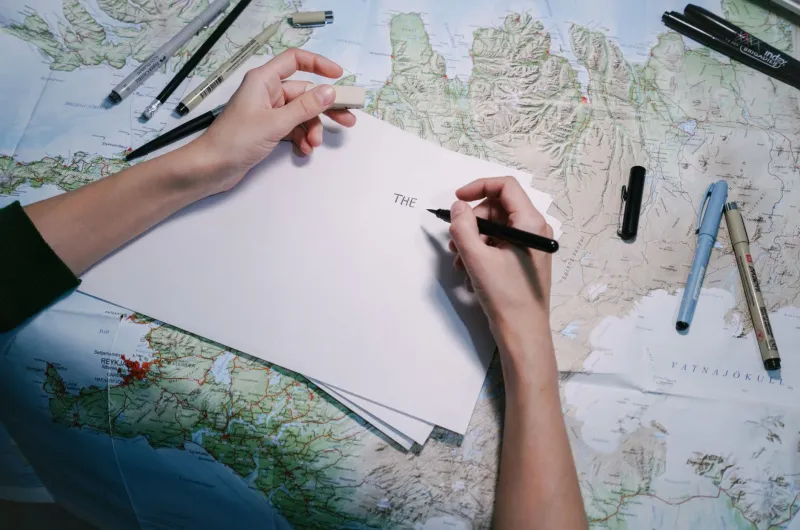
Open almost any published setting and you get the same artifact: a gorgeous, accurate, blessedly legible map. It's a gift. It's also the most railroad-adjacent piece of paper at your table, because a perfect map answers questions before your players think to ask them.
Real maps don't work that way. Pull the glovebox atlas out of any car in America and compare it to the actual road you're driving. The atlas shows you four lanes and an exit ramp; it does not show you the county road that saves twenty minutes, the diner with the good pie, or the bridge that's been out since spring. The map isn't lying, exactly. It just has priorities that aren't yours.
That gap — between what's drawn and what's true — is where exploration actually lives.
Nobody Draws a Map for Free
The fastest way to make cartography interesting is to ask who paid for it. Every map in your world has a patron, and every patron has a reason to nudge the ink.
A ducal survey puts the border three miles further east than the locals say it is. A temple map renders pilgrim routes thick and roads to rival shrines suspiciously faint. A merchant guild's chart is beautifully detailed along the coastline and practically blank inland, because inland doesn't move cargo. A village map drawn by a twelve-year-old is wildly inaccurate and includes every good fishing hole, which makes it the most useful map in the region.
Build two or three of these for your campaign and you've got instant worldbuilding that costs you nothing but a paragraph each. The map becomes a character with an agenda.
Three Kinds of Lies Worth Telling
Not all cartographic dishonesty serves the same purpose. Mix them deliberately.
Omission. Something isn't drawn. The old road, the shrine, the village that pays its taxes to somebody else. Omission creates discovery — the party finds what the map's owner wanted forgotten.
Bias. Something is drawn too big, too central, too important. A capital city that takes up three days of travel when it's really one. A river rendered as a highway when it's a seasonal trickle. Bias tells players who the mapmaker answers to, and it's funnier than a lore dump.
Error. Something is simply wrong. Not maliciously — just wrong. The ford is upstream now. The village moved after the flood. The cartographer copied a copy of a copy from sixty years ago, because that's how real cartography worked for most of history.
Error is the one GMs flinch at, because it feels like punishing players for using their resources. It isn't, as long as you handle it right.
The Table Needs a Floor
Here's the rule that keeps unreliable maps from becoming a table-flipping exercise: unreliable does not mean unusable.
Your map can lie about the details. It cannot lie about everything. Give the party at least one anchor per region — a mountain range, a coastline, a river they can trust — so navigation stays a puzzle and not a fog-of-war punishment. If the players make a reasonable plan based on reasonable information, that plan should mostly work. The map's errors should send them somewhere interesting, not somewhere stupid.
And never let a single failed check translate into six sessions of being lost in the woods. That's not exploration, that's a time-out.
Let Them Argue
The best moment in this whole approach is when you hand the party two maps that disagree. Not dramatically. Just enough.
The royal survey shows the lake. The fisherman's sketch shows a dry basin with a road through it. Both are dated within a decade of each other. Now you say nothing and let the table do the work.
Somebody will say the survey is old. Somebody else will point out the survey is newer. A third player will ask who benefits from the lake being on the map. That conversation is content. It's the party building a theory of the world, out loud, at your table, without you having to narrate a single thing.
When they finally ride out to check, the answer should be better than either map suggested. The lake is a dry basin because somebody upstream dammed it. There's a road through it because somebody wants travelers to take that route. Now you've got a faction, a problem, and a reason the party cares.
Contradiction Is a Quest Hook in Disguise
Every disagreement between two maps is a question, and every question is a job. Maps don't drift apart for no reason. Rivers get redirected, borders get argued, roads get closed, whole settlements get quietly erased because a landlord wanted the land.
So the next time your players ask for a map, hand them something with an author, a date, and at least one obvious grudge. Then sit back and let them interrogate it.
They'll trust it more than they ever trusted your perfect hex grid. People always trust the thing they had to argue with.